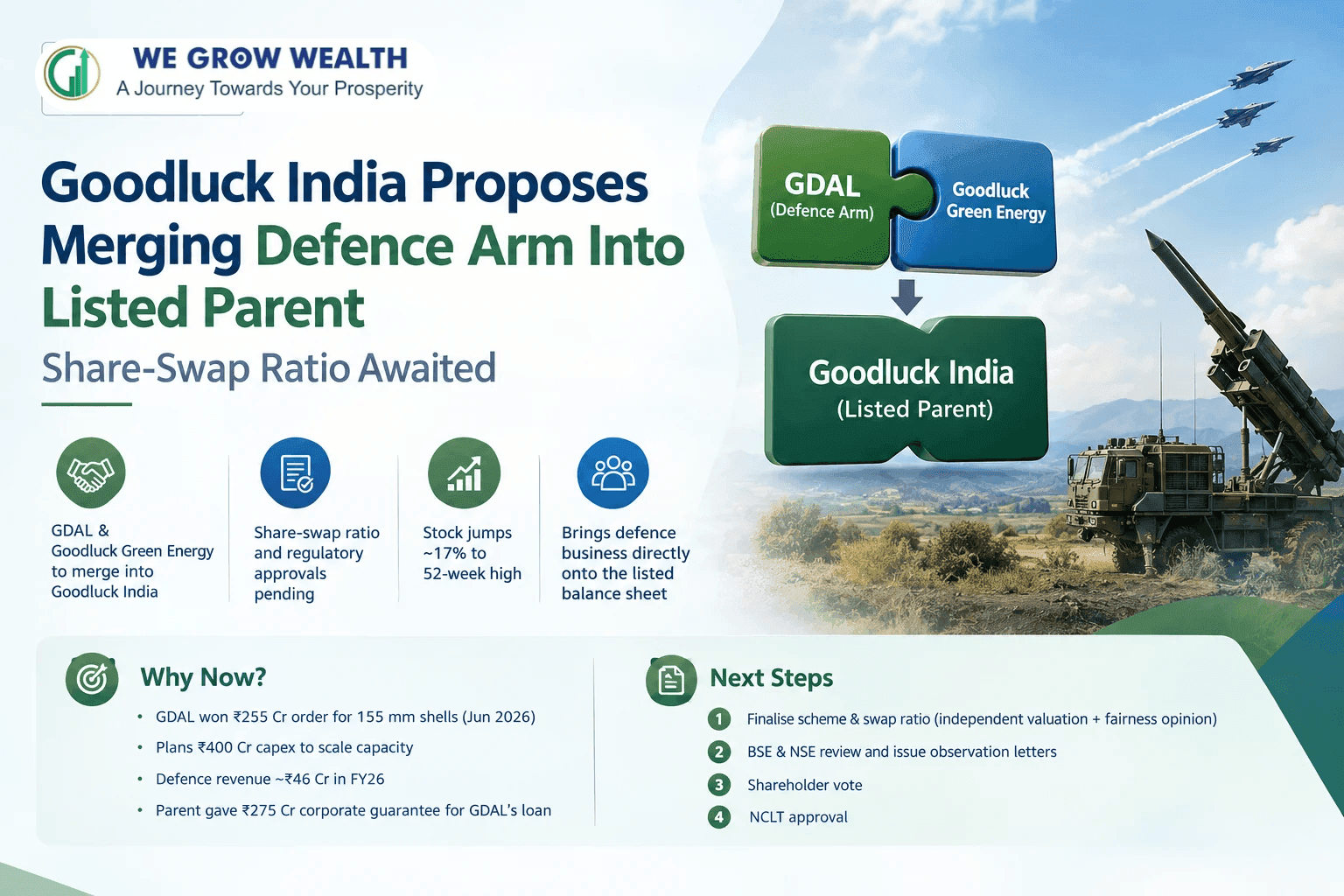
Goodluck India Plans Defence Arm Merger; Swap Ratio Awaited
Goodluck India Ltd has proposed merging its defence subsidiary, Goodluck Defence & Aerospace Ltd (GDAL), into the listed parent. The board gave in-principle approval at its meeting on October 12, 2026. The share-swap ratio and regulatory approvals are still pending.
What changed
The move widens a restructuring first announced on July 11, which covered only Goodluck Green Energy. Both GDAL and Goodluck Green Energy are now to be merged into Goodluck India. The company said detailed terms, structure and financial implications will be disclosed after final board approval. The stock jumped about 17% on the day to a 52-week high.
Why now
GDAL is in an expansion phase. It won a ₹255 crore order for 155 mm shells in June 2026, and management plans about ₹400 crore of capex to scale artillery shell capacity from 1.5 lakh to 4 lakh units a year. Defence revenue was about ₹46 crore in FY26, as commercial production only began during the year. The parent has also given a ₹275 crore corporate guarantee for GDAL’s bank loan.
Bringing the unit onto the parent’s balance sheet simplifies the group structure and gives investors direct exposure to the defence business through the listed entity.
Not wholly owned any more
On September 27, GDAL raised ₹276 crore by issuing 73.6 lakh shares at ₹375 each to non-promoter investors. This cut Goodluck India’s stake to 69.08%. The outside shareholders will receive Goodluck India shares in the merger, which is why the swap ratio matters.
What happens next
The board finalises the scheme and swap ratio, based on an independent valuation and a fairness opinion.
BSE and NSE review the scheme and issue observation letters.
Shareholders vote on it.
NCLT approval is required before the merger becomes effective.
Mergers of this kind typically take many months to complete.
What to watch
The swap ratio, especially against GDAL’s ₹375 recent issue price
Dilution for existing Goodluck India shareholders
Whether the defence business scales in line with management’s capex plans