
SIP vs Lump Sum Investment Which Is Better for Long-Term Wealth Creation?
Every investor eventually faces this question. You have money — either a monthly surplus or a windfall — and you need to decide how to deploy it. The financial world has debated SIP vs Lump Sum for decades, and the honest answer is more nuanced than any single recommendation. But there is a right answer for most people, most of the time. Here it is.
"Lump sum wins in bull markets. SIP wins in volatile ones. Discipline wins in all markets."
The Difference in One Paragraph Each
A Systematic Investment Plan (SIP) means investing a fixed amount — say ₹10,000 — into a mutual fund at regular intervals, typically monthly. You buy more units when markets are down and fewer when they are up. Over time, this averages out your purchase cost — a concept called Rupee Cost Averaging. The single biggest advantage of SIP is that it removes the need to time the market.
A Lump Sum investment means deploying a large amount all at once. If you invest ₹5 lakh today, all of it is exposed to the market from Day 1. If the market rises, you win big. If it falls immediately after, your entire corpus takes the hit. The advantage is full exposure to compounding from the moment of investment. The risk is timing.
The Numbers: ₹12,000/Month SIP vs ₹1.44 Lakh Lump Sum (15 Years, 12% CAGR)
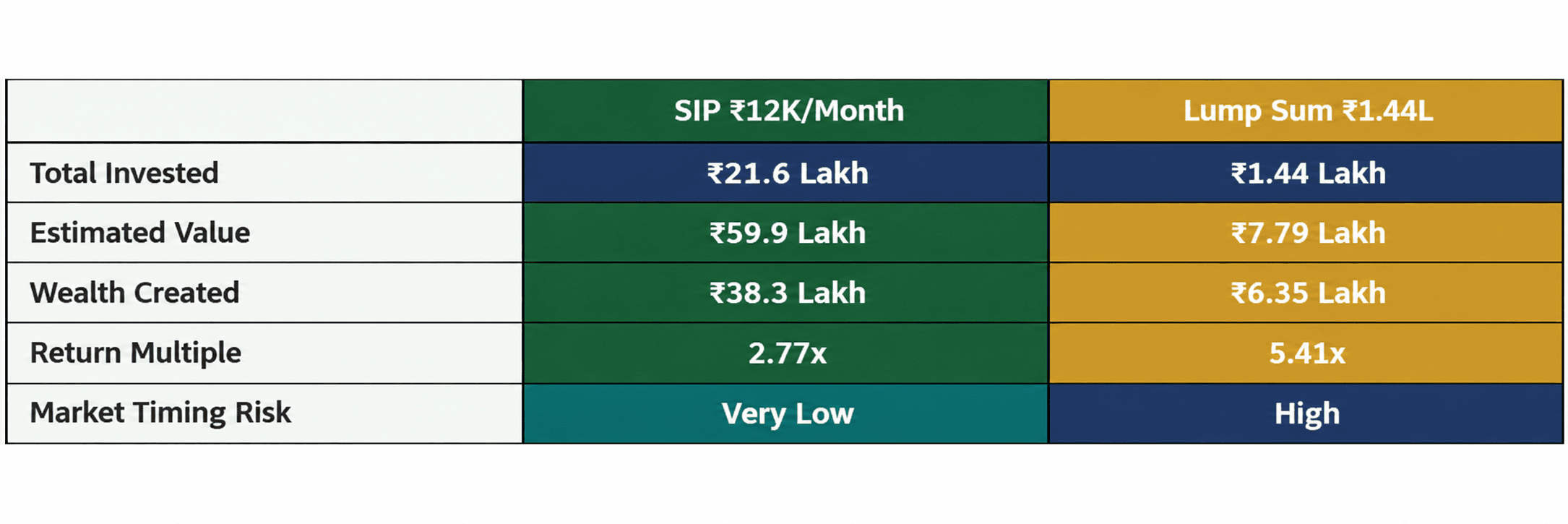
The lump sum delivers a higher return multiple — but only if deployed at the right time and left untouched. The SIP invested ₹15x more capital over 15 years, created more absolute wealth, and the investor never had to guess where the market was headed. Both strategies work. The question is which one you will actually stick with.
When Each Strategy Wins
• You have regular income and want to invest monthly from your salary
• You are new to investing and nervous about market volatility
• Markets are at or near all-time highs and valuations look stretched
• You want to build discipline — SIP is an automatic saving habit
• Your investment horizon is 7–10+ years across full market cycles
• Markets have just corrected 20–30%+ and valuations are cheap
• You received a windfall — bonus, inheritance, property sale proceeds
• You have a genuinely long horizon (10+ years) and high risk tolerance
• The asset class is at historically low valuations (e.g. mid-cap after a crash)
• You want maximum compounding from Day 1 on a corpus you won't touch
The Honest Answer Most Advisers Skip
Academic research consistently shows that lump sum investing outperforms SIP roughly 68–70% of the time over long periods — simply because markets trend upward over time, and being fully invested from Day 1 captures more of that upward trend. SIP outperforms in the remaining 30% of cases — specifically when markets decline or are choppy after your investment date.
But here is what the data cannot capture: most investors do not have a lump sum. They have a salary. And even those who do have a lump sum often freeze, delay, or invest in parts because timing the market feels paralyzing. SIP removes that friction entirely. A strategy you execute beats a strategy you do not. For most Indian retail investors — earning a regular income, investing for retirement or goals 10–15 years away, without the ability or confidence to time market entries — SIP is not the second-best option. It is the right option.
"The best investment strategy is the one you will actually follow for 15 years without flinching at a correction."
THE SMART HYBRID APPROACH — WHAT SOPHISTICATED INVESTORS DO
Do not choose between SIP and Lump Sum. Use both. Run a base SIP every month for discipline and rupee cost averaging. Keep a "war chest" — a liquid fund holding of 10–20% of your investment portfolio — ready to deploy as Lump Sum during sharp market corrections (Nifty down 15%+). This way you capture the emotional discipline of SIP and the tactical opportunism of lump sum timing. Most wealth managers managing ₹2Cr+ HNI portfolios run exactly this structure.
Final Thought
SIP vs Lump Sum is ultimately the wrong question. The right question is: what structure will keep me invested, through every correction, for long enough that compounding does its real work? For most investors, that is a regular SIP with opportunistic lump sum additions on market dips. The math favours staying invested over being clever about entry points. Time in the market — not timing the market — remains the only reliable edge available to a retail investor.
Disclaimer: For informational purposes only. Mutual fund investments are subject to market risk. Past returns are not indicative of future performance. Consult a SEBI-registered adviser before investing.
Start Your SIP or Lump Sum Investment with We Grow Wealth
Noida-based wealth management firm offering personalized mutual fund advisory, SIP planning, PMS, AIF, and unlisted/pre-IPO investment services for HNI and retail investors.
+91 8750563151 | www.wegrowwealth.in | info@wegrowwealth.in