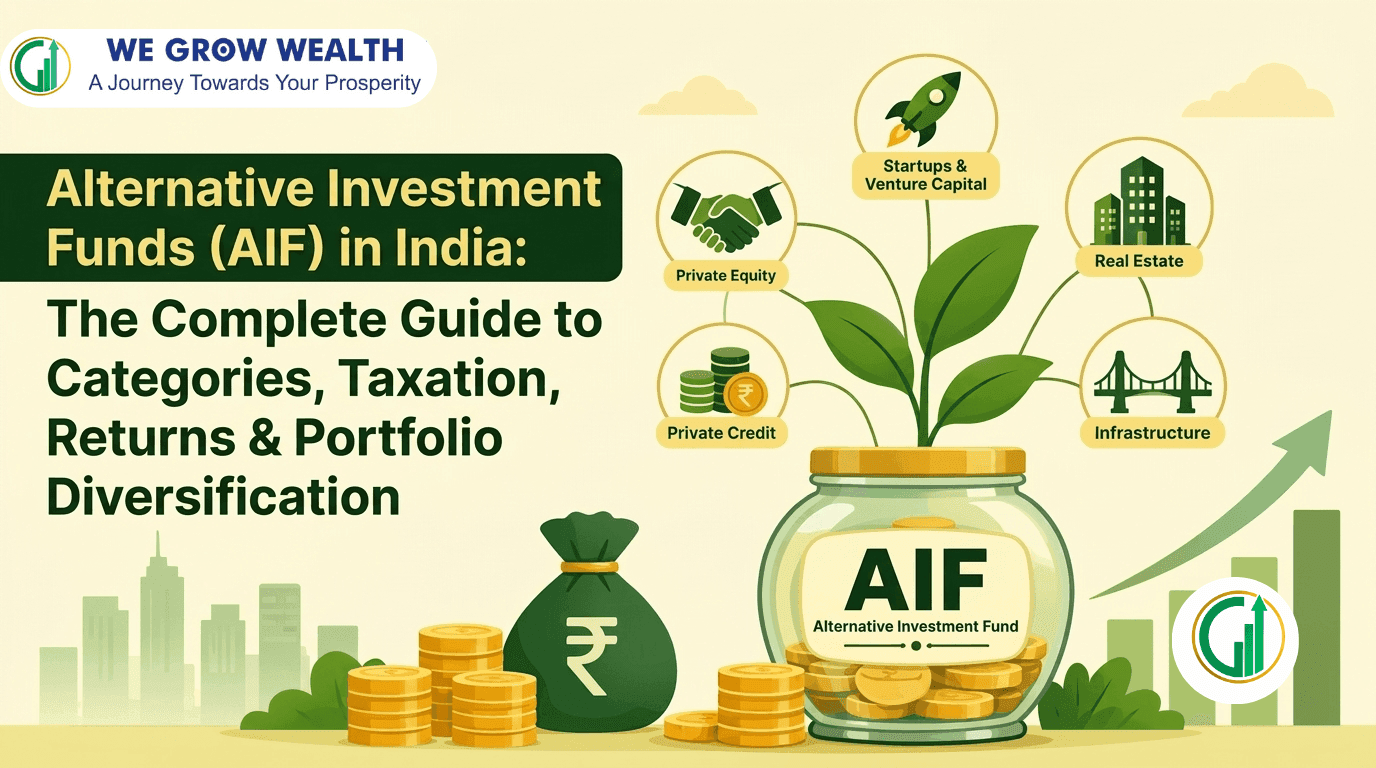
Alternative Investment Funds (AIF) in India: The Complete Guide to Categories, Taxation, Returns & Portfolio Diversification
India's HNI and ultra-HNI investor community has a problem that good returns alone cannot solve: diminishing diversification. Public markets — equities, bonds, mutual funds — move together, especially during global stress events. When Sensex corrects 20%, most traditional portfolios correct alongside it. AIF investment was designed to solve this problem — by giving sophisticated investors access to private markets, real assets, and complex strategies that have low or zero correlation to listed market cycles.
AIF investment in India has grown from a ₹30,000 crore industry in 2015 to over ₹13 lakh crore in committed capital by 2025 — a 43x expansion in a decade. This is not a niche product anymore. For investors with ₹3 crore or more in investable assets, AIF investment is increasingly a core component of a well-constructed portfolio, not an optional add-on.
This complete guide covers every dimension of AIF investment: what it is, the regulatory framework, how each category works, who it is designed for, how to evaluate a fund, and the tax treatment that every investor must understand before committing capital.
1. What Is AIF Investment? The Regulatory Definition
Under the SEBI (Alternative Investment Funds) Regulations, 2012, an AIF is defined as any fund established or incorporated in India that is a privately pooled investment vehicle which collects funds from investors, whether Indian or foreign, for investing in accordance with a defined investment policy for the benefit of its investors.
In practice, AIF investment means committing capital to a professionally managed fund that deploys money into private equity, venture capital, real estate, private credit, hedge strategies, infrastructure, or distressed assets — all of which fall outside the conventional listed equity and debt markets accessible through mutual funds or direct stock purchases.
"AIF investment gives sophisticated investors a seat at the table for opportunities that public markets simply cannot offer — the next Zepto before it lists, the real estate project before it is built, the credit deal before it is rated."
Key regulatory facts: AIFs must be registered with SEBI. The fund manager must hold a valid SEBI registration. The minimum investment per investor is ₹1 crore (₹25 lakh for employees and directors of the AIF or its manager). Each AIF scheme can accept up to 1,000 investors. The minimum corpus is ₹20 crore (Category I & II) or ₹10 crore (Category III).
2. The Three Categories of AIF Investment
Every AIF investment in India falls into one of three SEBI-defined categories. The category determines the asset class, regulatory treatment, leverage limits, and tax structure — making it the single most important dimension of any AIF investment decision.
Category | Investment Focus | Examples | Leverage | Tax Treatment |
Category I | Socially & economically beneficial sectors | VC Funds, Angel Funds, SME Funds, Infra Funds, Social Venture Funds | Not permitted | Pass-through — investor-level taxation; VCFs exempt u/s 10(23FB) |
Category II | Private equity, debt, and real assets (mainstream AIF investment) | PE Funds, Debt Funds, Real Estate Funds, Fund of Funds | Not permitted (day-to-day operational only) | Pass-through for most income; business income taxed at fund level; ~80% of India AIF AUM |
Category III | Complex / hedge strategies targeting absolute returns | Hedge Funds, Long-Short Equity, PIPE Funds, Multi-Strategy Funds | Permitted (SEBI-defined limits) | No pass-through; taxed at fund level at max marginal rate (~42.7%) |
3. How AIF Investment Works: The Mechanics
Understanding the mechanics of AIF investment helps investors set realistic expectations around timelines, capital deployment, returns, and liquidity.
The Fund Lifecycle
1 | Fund Formation & SEBI Registration The fund manager registers the AIF with SEBI, defines the investment strategy, target sectors, and return objectives in a Private Placement Memorandum (PPM). The fund is typically structured as a trust in India. |
2 | Fundraising & Capital Commitments Investors commit capital (not yet deployed). The fund accepts commitments up to its target corpus — e.g., ₹500 crore. The ₹1 crore minimum applies per investor at this stage. |
3 | Capital Calls & Deployment (Investment Period) The manager draws down committed capital in tranches (capital calls) as investment opportunities are identified. The investment period typically spans 2–4 years. This is when your AIF investment moves from commitment to actual deployment. |
4 | Portfolio Management & Value Creation The fund actively manages its portfolio — through board representation, strategic input, follow-on investments, or credit monitoring depending on the strategy. This is the longest phase: typically 3–5 years. |
5 | Exit & Distribution The manager exits investments via IPO, strategic sale, secondary sale, or redemption. Proceeds are distributed to investors after deducting fees and carried interest. The total fund life is typically 7–10 years for Cat I & II. |
The J-Curve: What Every AIF Investor Must Understand
AIF investment returns follow a J-curve pattern. In the early years, your net return is negative — because management fees are being charged but investments have not yet matured. Returns typically inflect upward in years 3–5 as exits begin and valuations are realised. The J-curve is not a warning sign — it is simply the nature of private market investing. Investors who exit early or panic at the initial dip miss the bulk of the return.
4. AIF Investment vs Other Products: Where It Fits
Feature | Mutual Fund | PMS | AIF Investment | Direct Equity |
Min. Ticket | ₹500 | ₹50 Lakh | ₹1 Crore | Any amount |
Asset Universe | Listed MF/Debt | Listed equity | Private, Unlisted, Hedge | Listed equity only |
Liquidity | T+1 to T+3 | Moderate | Low (3–7 yr lock-in) | T+1 (exchange hours) |
Return Driver | Market beta | Alpha + beta | Absolute / private mkt IRR | Market beta + stock alpha |
Downside in crash | Full market drop | Partial buffer | Low / zero correlation | Full market drop |
Investor type | All investors | HNI | HNI / UHNI / Institutional | All investors |
Transparency | Daily NAV | Real-time | Quarterly reports | Real-time |
Tax | MF slab rules | Investor-level | Category-dependent | STCG 20% / LTCG 12.5% |
5. Types of AIF Investment Strategies
Within each category, AIF investment spans a wide range of strategies. Here is a practical breakdown of the most common AIF investment strategies available to Indian HNIs:
Strategy | Category | Target Return | Risk Level | Ideal Holding |
Venture Capital / Angel | Cat I | 5–20x MOIC (high variance) | Very High | 7–10 years |
Growth Private Equity | Cat II | 20–28% IRR | High | 5–7 years |
Buyout PE | Cat II | 18–24% IRR | Moderate-High | 4–6 years |
Private Credit / Debt | Cat II | 14–18% pre-tax yield | Moderate | 2–4 years |
Real Estate AIF | Cat II | 15–20% IRR | Moderate-High | 4–6 years |
Infrastructure AIF | Cat I | 12–16% IRR | Low-Moderate | 7–10 years |
Long-Short Equity (Hedge) | Cat III | 15–20% absolute returns | Moderate-High | 1–3 years |
Multi-Strategy Hedge | Cat III | 12–18% absolute returns | Moderate | 2–3 years |
Distressed / Special Situations | Cat II | 20–30% IRR | Very High | 3–5 years |
6. Tax on AIF Investment: What You Must Know
Tax treatment is one of the most frequently misunderstood aspects of AIF investment. The category of the fund determines not just where the tax falls, but the effective tax rate — and therefore the net return to the investor.
AIF Category | Tax Principle | Equity Gains | Debt / Other Income | Effective Tax Impact |
Category I | Pass-through | LTCG 12.5% / STCG 20% (in investor's hands) | Taxed at investor's slab rate | Most tax-efficient for high-bracket investors using LTCG route |
Category II | Partial pass-through | LTCG 12.5% / STCG 20% | Business income taxed at fund level at MMR | Generally efficient; check nature of income in fund's PPM |
Category III | Fund-level tax | Taxed at MMR (~42.74% incl. surcharge) at fund level | Same — all income at MMR | Least efficient; gross return must be significantly higher to net the same as Cat II |
The Net IRR Test for AIF Investment
Always ask your fund manager for the net IRR after fees and tax — not gross IRR. A Category III AIF offering 22% gross returns may deliver only 12–13% net after the ~42.7% fund-level tax and 2% management fee. A Category II AIF offering 18% gross with pass-through tax may deliver 14–15% net for an investor in the 30% bracket. Net IRR, not gross, is the only number that matters.
7. AIF Investment Costs & Fee Structure
AIF investment carries a distinct fee structure that differs significantly from mutual funds. Understanding these costs upfront is non-negotiable before committing capital.
Fee Component | Typical Range | Charged On | Notes |
Management Fee | 1.5–2.5% per annum | Committed or invested capital | Charged from Day 1 regardless of deployment — feeds the J-curve dip |
Setup / Onboarding Fee | 0.5–1% (one-time) | Committed capital | Some funds waive for large tickets |
Hurdle Rate | 8–10% per annum | Fund-level IRR | Manager earns carry only after crossing this threshold |
Carried Interest | 15–20% of profits | Returns above hurdle rate | Standard is 20%; some funds offer 15% for early/large commitments |
Exit / Redemption Fee | 0–1% | Redemption amount | Applies mainly to Cat III open-ended funds |
Placement / Dist. Fee | 0–1% (one-time) | Committed capital | Paid to distributor/wealth manager; check if passed to investor |
8. Who Should Make an AIF Investment?
AIF investment is not suitable for every investor. SEBI's minimum ticket size of ₹1 crore is a deliberate filter designed to restrict access to investors with the sophistication and financial resilience to absorb illiquidity, complexity, and potential capital loss. Here is a practical framework for assessing fit:
Investor Profile | Recommended AIF Investment | Rationale |
HNI — ₹3–5Cr investable assets | Cat II PE or Private Credit AIF | First AIF investment: moderate risk, strong yield, 4–6 yr lock-in |
Business Owner / Promoter | Cat I VC Fund or Cat II PE | Domain expertise advantage; startup ecosystem access; tax-efficient |
UHNI / Family Office (₹20Cr+) | Multi-category AIF portfolio | Full spectrum: VC + PE + credit + hedge + RE for true diversification |
Yield-Seeker (conservative HNI) | Cat II Private Debt / Credit AIF | 14–18% pre-tax fixed yield with collateral — beats FDs and NCDs significantly |
Real Estate Investor | Cat II Real Estate AIF | Diversified RE exposure without physical asset hassle, RERA risk, or black money |
Market-Savvy Investor (Cat III) | Long-Short or Multi-Strategy Hedge | Market-neutral alpha; useful in sideways or volatile Sensex environments |
NRI Investor | Cat II (FEMA-compliant) AIF | Can invest via NRE/NRO accounts; FEMA rules apply — verify with CA first |
Corporate Treasury | Cat II Debt AIF or Cat III low-risk | Regulatory-compliant yield enhancement on idle cash above FD rates |
Before Your First AIF Investment — A Checklist
Is your core portfolio (equity, debt, insurance, estate) already structured? ✓ Do you have a liquid emergency fund of 6–12 months expenses set aside? ✓ Can you lock in ₹1 crore for 5–7 years without needing it? ✓ Have you read the fund's PPM (Private Placement Memorandum) fully? ✓ Have you verified the manager's SEBI registration and past fund track record? ✓ Have you consulted a CA on the tax treatment specific to this fund? ✓ If all six are yes — you are ready for AIF investment.
9. How to Evaluate an AIF Investment Opportunity
• Fund Manager Track Record: Request audited IRRs and MOIC (Multiple on Invested Capital) across all previous fund vintages — not just the current one. Look for actual exits with cash-on-cash returns, not only unrealised marked-up valuations. A great pitch deck with no exits is not a track record.
• Strategy-Market Fit: Is the AIF investment strategy suited to current market conditions? A distressed debt fund in a bull market may struggle to find deals. A growth PE fund in a slowdown may face valuation headwinds. Evaluate timing, not just strategy.
• Portfolio Construction: How many companies or assets will the fund invest in? 8–15 is typical for PE; fewer for VC (higher concentration, higher risk). Ask about the current pipeline — how many deals are already identified versus theoretical.
• Co-investment Rights: The best AIF investment relationships offer co-investment rights — the ability to invest directly into specific portfolio companies alongside the fund, often at lower or zero fees. This is a significant value-add for UHNI investors.
• Exit Track Record: How has the manager exited previous investments? IPO, strategic sale, or secondary buyout? A fund that has never executed an exit is an unproven manager regardless of paper returns.
• Governance & LP Rights: What reporting will you receive? How frequently? What rights do limited partners have to call an LP meeting or replace the manager in extreme circumstances? Investor protection mechanisms matter.
• Distributor vs Direct: Are you accessing the AIF investment through a SEBI-registered distributor or directly? Distributors earn a placement fee — understand who pays it and whether it impacts your returns. Always clarify the total cost of access.
10. AIF Investment Risks — An Honest Assessment
Risk | Description | How to Mitigate |
Illiquidity | Capital locked for 3–7+ years with no secondary market exit | Only invest capital you genuinely will not need in that window |
Manager Risk | Returns entirely dependent on fund manager quality and judgment | Verify track record across multiple vintages; check team stability |
Valuation Risk | Unlisted assets valued quarterly on models, not market prices | Focus on realised returns (exits), not just reported NAV upgrades |
Concentration | Typical AIF holds 8–15 positions; one bad bet impacts fund materially | Diversify across 2–3 AIFs and categories; avoid putting all eggs in one fund |
Regulatory Risk | SEBI AIF framework evolving; tax rules subject to change | Work with a qualified CA; stay updated on SEBI circulars |
Currency Risk | Funds investing overseas expose INR investors to USD/EUR volatility | Understand the fund's currency exposure and hedging policy |
J-Curve Risk | Negative returns in early years before portfolio matures | Commit only what you don't need to report as gains for 3+ years |
Final Thought: Is AIF Investment Right for Your Portfolio?
AIF investment represents the frontier of sophisticated investing in India — a space where the returns are real, the risks are real, and the manager's skill makes all the difference. For investors who have built their core portfolio, have genuine long-term capital to commit, and are prepared to do the diligence that private market investing demands, AIF investment can meaningfully improve risk-adjusted returns, reduce public market correlation, and provide access to India's most compelling growth opportunities — before they become public knowledge.
The question is not whether AIF investment is good or bad. It is whether it is right for you, in the right category, through the right manager, at the right stage of your wealth journey. Get those four elements right, and AIF investment becomes one of the most powerful tools in the modern Indian HNI's arsenal.
"The best AIF investment is not the one with the highest gross return target. It is the one where the manager has done it before, the strategy fits the market, and the net return — after fees and tax — actually reaches your account."
Disclaimer: This blog is for informational and educational purposes only. AIF investment is subject to market risk, illiquidity risk, regulatory risk, and possible loss of principal. Minimum investment of ₹1 crore applies. Past performance of any AIF or fund manager does not guarantee future results. Tax treatment is subject to applicable laws and individual circumstances. Please consult a SEBI-registered investment adviser and a qualified Chartered Accountant before making any AIF investment decision.
Explore Curated AIF Investment Opportunities with We Grow Wealth
We Grow Wealth Pvt. Ltd. provides curated AIF investment access across Category I, II, and III funds — spanning private equity, venture capital, private credit, real estate, and hedge strategies. Our team evaluates each AIF investment opportunity with investment-grade due diligence and guides clients through SEBI compliance, tax structuring, and portfolio integration.
+91 8750563151 | www.wegrowwealth.in | info@wegrowwealth.in