
What Is an AIF? Who Should Invest in Alternative Investment Funds?
For most of the last two decades, the Indian investor's toolkit was simple: fixed deposits, mutual funds, and equity. But India's growing class of high-net-worth individuals (HNIs) and sophisticated investors has long needed more — higher return potential, true portfolio diversification, and access to opportunities unavailable in public markets. Alternative Investment Funds (AIFs) were created precisely to fill that gap.
Since SEBI introduced the AIF framework in 2012, the industry has grown from a niche product into a ₹13+ lakh crore ecosystem — encompassing venture capital, private equity, hedge funds, real estate, and infrastructure debt. Yet most investors still do not fully understand what an AIF is, how it works, or whether it belongs in their portfolio.
This guide covers everything you need to know.
What Is an Alternative Investment Fund (AIF)?
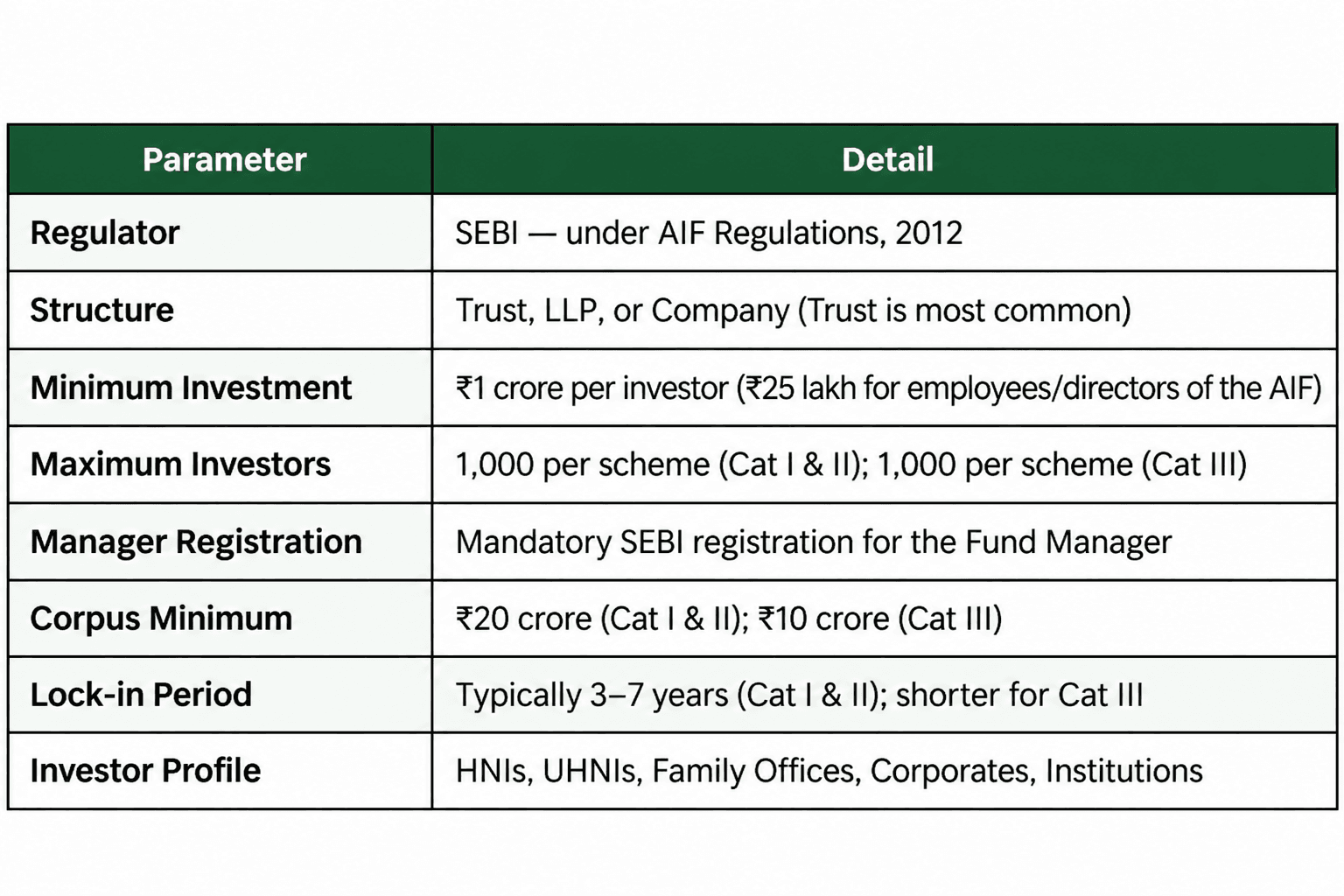
An Alternative Investment Fund is a privately pooled investment vehicle that collects funds from sophisticated investors — whether Indian or foreign — and invests them in accordance with a defined investment policy. AIFs are regulated by the Securities and Exchange Board of India (SEBI) under the SEBI (Alternative Investment Funds) Regulations, 2012.
The key word is alternative. An AIF invests in assets or strategies that fall outside the conventional publicly listed equity and debt markets — think startup equity, private credit, real estate, distressed assets, or long-short equity strategies. This is what gives alternative investment funds their potential for higher absolute returns and low correlation with traditional market cycles.
"Alternative Investment Funds are not just another product. They are a different philosophy of investing — one built on exclusivity, expertise, and long-term capital deployment."
AIF at a Glance
The Three Categories of Alternative Investment Funds
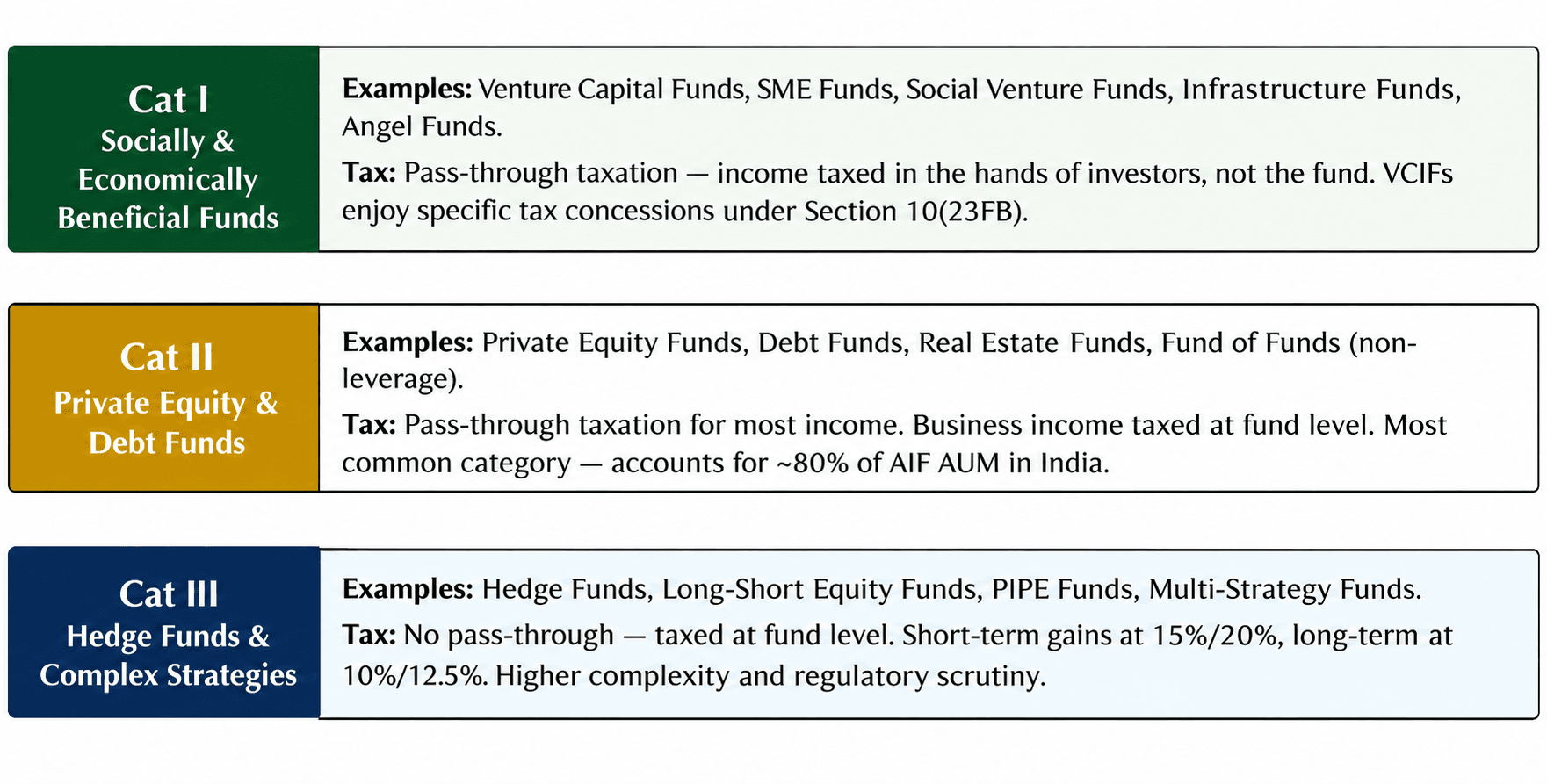
SEBI classifies all alternative investment funds into three categories based on their investment focus, risk profile, and the regulatory treatment accorded to them. Understanding these categories is the foundation of any AIF investment decision.
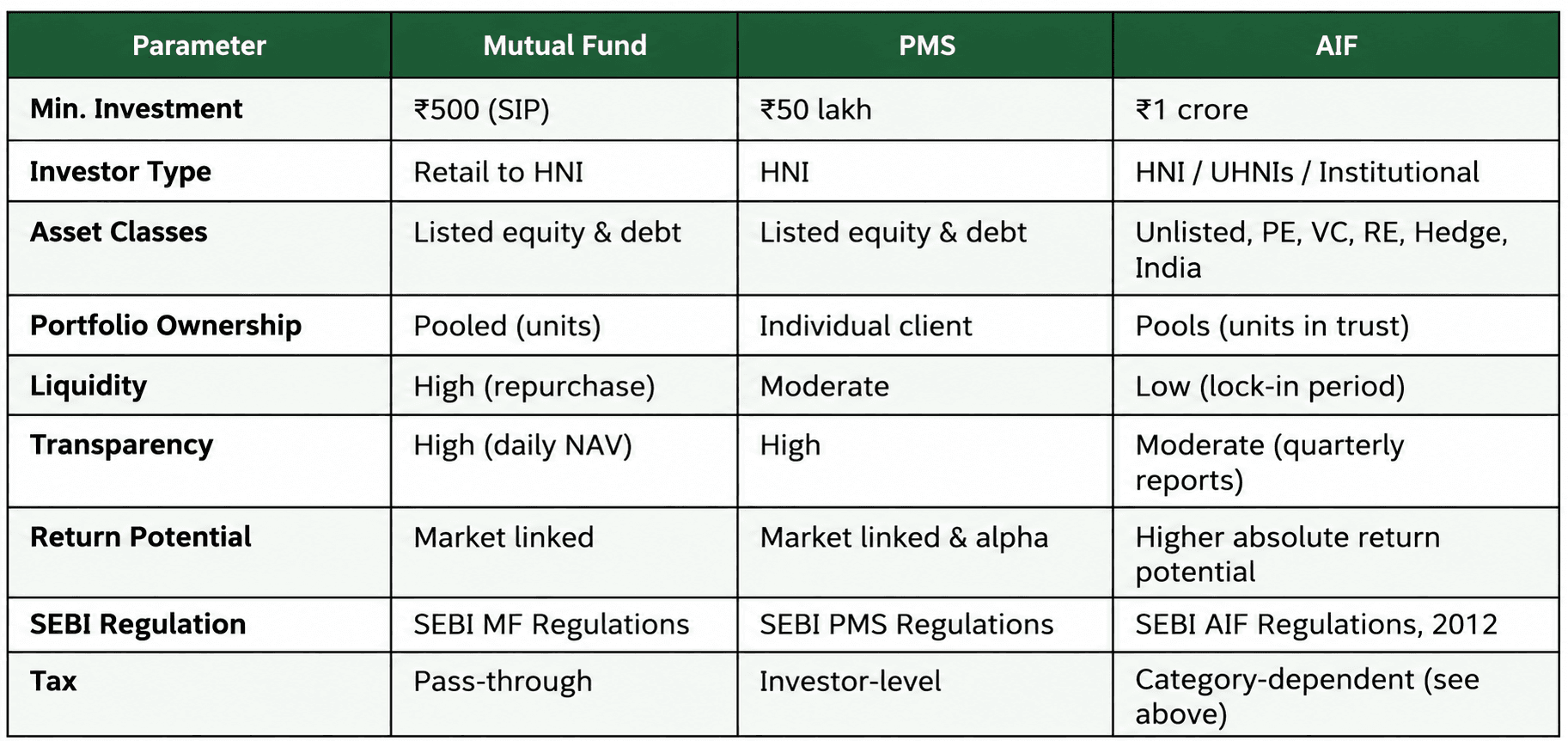
AIF vs Mutual Fund vs PMS: How They Compare
What Do Alternative Investment Funds Invest In?
The breadth of alternative investment funds is one of their defining characteristics. Depending on the category and strategy, an AIF can invest across:
• Venture Capital & Startup Equity: Early to growth-stage investments in private companies before they list. Returns can be 5–20x over a 7–10 year horizon, but risk of capital loss is real. Suited for investors with genuine risk appetite and long time horizons.
• Private Equity: Growth capital or buyout investments in established private businesses. Typically 4–7 year holding periods with targeted IRRs of 18–25%. The backbone of Category II AIF activity in India.
• Private Credit & Debt: Structured lending to mid-market companies at rates of 14–18% — higher than bank rates but backed by collateral and covenants. Growing rapidly as an asset class for yield-seeking HNIs.
• Real Estate: Direct property investments, construction finance, or mezzanine debt in real estate projects — offering yield plus appreciation without the liquidity risk of owning physical property.
• Hedge / Long-Short Equity (Cat III): Market-neutral or directional strategies using listed equities, derivatives, and other instruments. Targets absolute returns irrespective of market direction.
• Infrastructure & ESG Funds: Category I funds investing in roads, renewable energy, social infrastructure — often with government co-investment or guarantees, targeting stable 12–15% IRRs.
• Distressed Assets: Acquiring stressed or NPL (non-performing loan) assets at a discount and resolving them for capital gains — a specialised, high-risk, high-reward niche within Cat II.
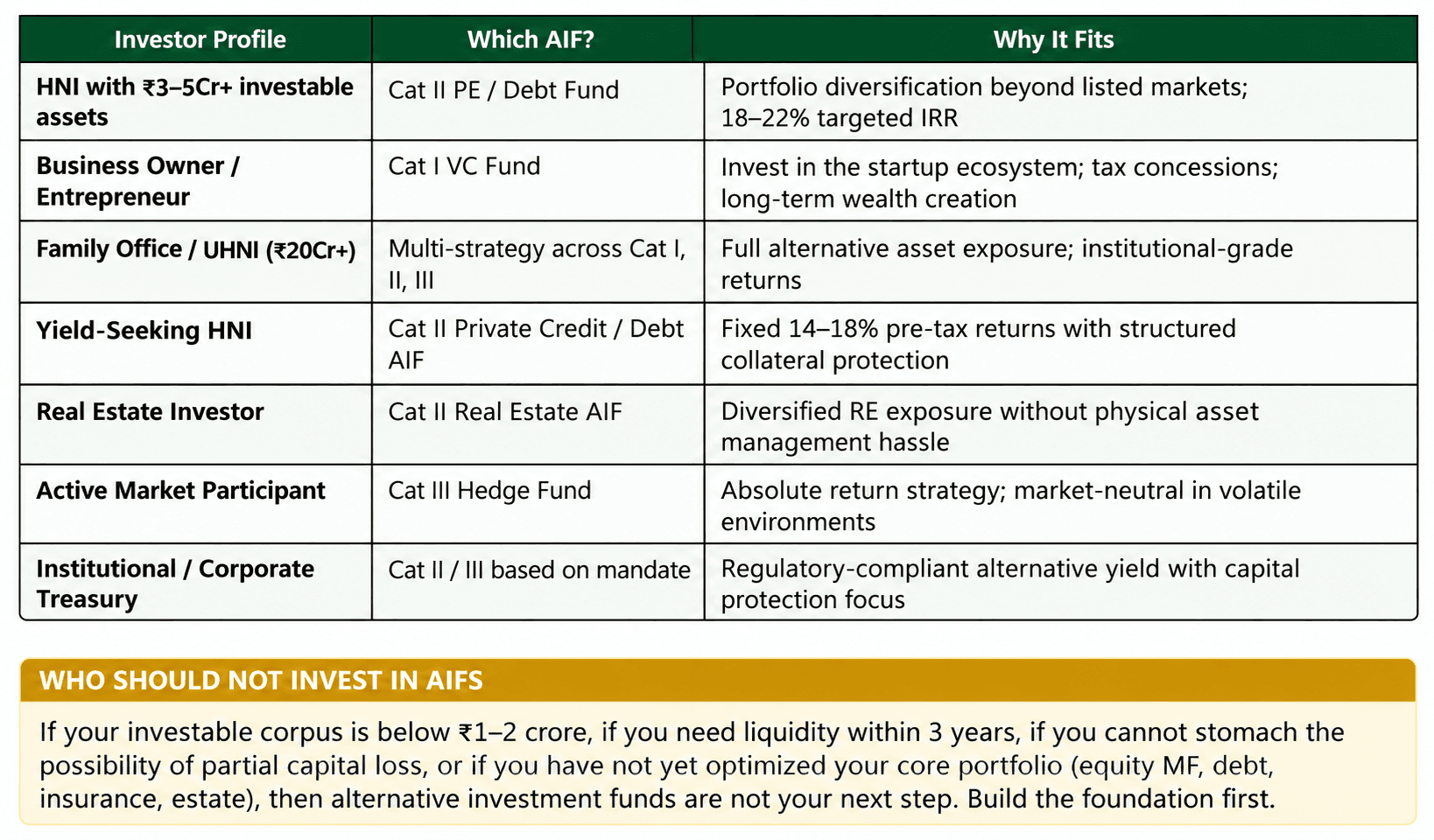
Who Should Invest in Alternative Investment Funds?
AIFs are not designed for every investor. SEBI's ₹1 crore minimum ticket size is a deliberate filter — it is intended to limit alternative investment funds to sophisticated investors who understand and can absorb illiquidity and complexity. Here is how to think about fit:
Key Risks of Alternative Investment Funds
No honest AIF guide is complete without a clear-eyed look at the risks. Alternative investment funds carry a distinct risk profile that is fundamentally different from mutual funds:
• Illiquidity Risk: Most Cat I and II AIFs have lock-ins of 3–7 years. Your capital is committed for the duration. Unlike a mutual fund, you cannot redeem on demand. This is the defining trade-off for the return premium.
• Manager Risk: AIF returns are heavily dependent on the quality and track record of the fund manager. Unlike passive index funds, there is no benchmark to hide behind — manager skill is everything.
• Valuation Risk: Unlisted investments are not marked to a daily NAV. Quarterly valuations are based on models and comparables, not real-time market prices — meaning you may not know the true value of your portfolio until an exit event.
• Concentration Risk: A typical AIF invests in 8–15 companies or projects. One bad investment can meaningfully drag down fund-level returns. Diversification across multiple AIFs mitigates this.
• Regulatory & Tax Risk: The SEBI AIF framework is still evolving. Tax treatment of Category III AIFs is complex and subject to interpretation. Always consult a CA before committing capital.
Tax Treatment of AIFs in India
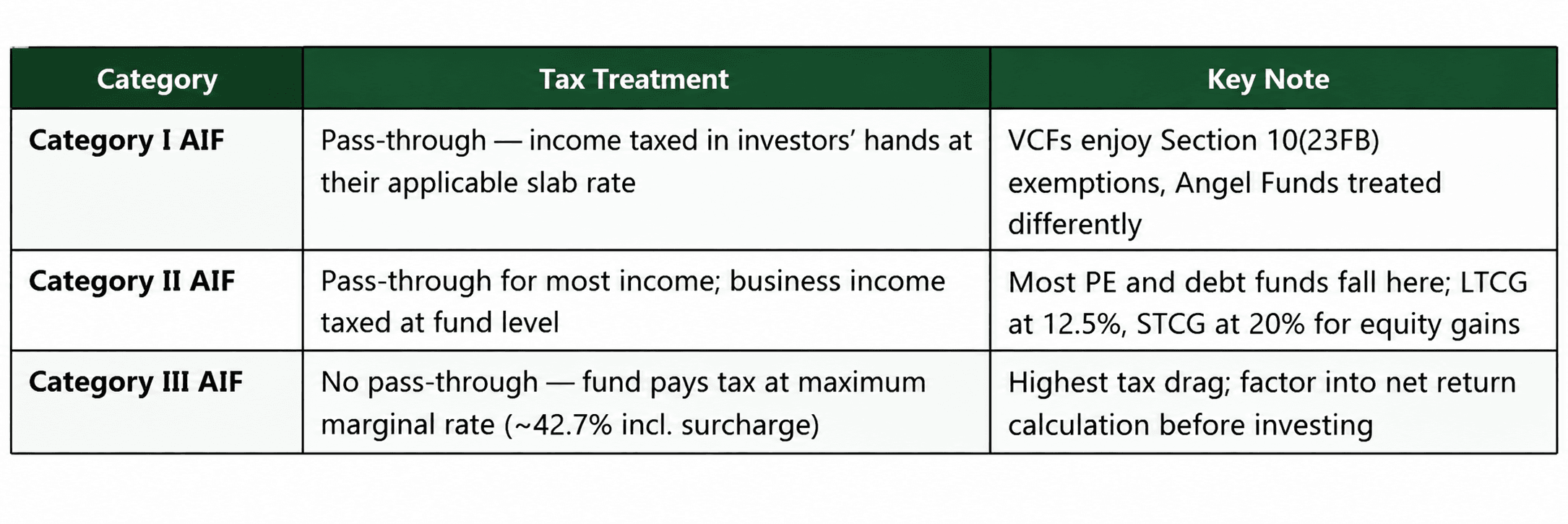
Tax efficiency is a critical factor in AIF selection. A Category III AIF targeting 20% gross returns may deliver only 11–12% net post-tax — making a Category II fund targeting 18% gross potentially more attractive on an after-tax basis. Always evaluate on net IRR, not gross.
How to Evaluate an AIF Before Investing:
• Track Record: Ask for audited IRRs across previous vintages (not just the current fund). Look for at least one full investment cycle with actual exits — not just marked-up valuations.
• Fund Manager Pedigree: Who is the investment team? What is their domain expertise? Have they managed capital through a full cycle including a downturn? AIF investing is a bet on the manager as much as the strategy.
• Fee Structure: Standard AIF fees: 1.5–2.5% management fee per annum on committed capital + 20% carry (performance fee) above an 8% hurdle rate. Understand the waterfall and carry structure before signing.
• Portfolio Transparency: How frequently does the manager report? What is the quality of quarterly investor letters? A fund that communicates clearly in good times and bad is a fund you can trust.
• Deployment Timeline: How quickly will your capital be deployed? A 7-year fund that takes 3 years to fully deploy has only 4 years to generate returns. Understand the J-curve — the initial period where fees are paid but returns not yet realised.
• Exit Strategy: How does the fund plan to exit its investments? IPO? Strategic sale? Secondary sale? Without a credible exit strategy, returns remain theoretical.
Final Thought: Are Alternative Investment Funds Right for You?
Alternative investment funds represent one of the most powerful tools available to the modern Indian HNI — but only when used correctly. They are not a replacement for a well-structured core portfolio. They are a complement to it — one that can enhance returns, reduce correlation to public market volatility, and provide access to India's most compelling private market opportunities.
The right approach: build your core portfolio first (equity, debt, insurance, estate plan). Once your investable assets cross ₹3–5 crore and your core is optimised, allocate 15–25% to alternative investment funds across categories and strategies — guided by a trusted adviser who understands both the regulatory framework and the return dynamics.
"In investing, what is comfortable is rarely profitable. Alternative investment funds exist precisely to take you beyond comfortable — with structure, diligence, and the right guidance."
Disclaimer: This blog is for informational and educational purposes only. Alternative Investment Funds are subject to market risk, illiquidity risk, and regulatory risk. Minimum investment of ₹1 crore applies. Past performance of any AIF does not guarantee future returns. Please consult a SEBI-registered investment adviser and qualified CA before investing.
Explore AIF Opportunities with We Grow Wealth
We Grow Wealth Pvt. Ltd. is a Noida-based wealth management firm with access to curated Category I, II, and III AIF opportunities across private equity, private credit, venture capital, and real estate strategies. We help our clients evaluate, access, and track alternative investment funds with investment-grade research and full regulatory compliance.
+91 8750563151 | www.wegrowwealth.in | info@wegrowwealth.in