
Financial Planning for Retirement & Financial Planning for High-Income Individuals
India has no universal pension. No social security net. The responsibility of building a life after work falls entirely on the individual — and yet most Indians, even high earners, begin serious financial planning a decade too late. Whether you are a salaried professional thinking about retirement or a high-income entrepreneur managing complex finances, financial planning is not optional. It is the difference between a dignified future and a financially dependent one.
"The best time to start financial planning was yesterday. The second best time is today."
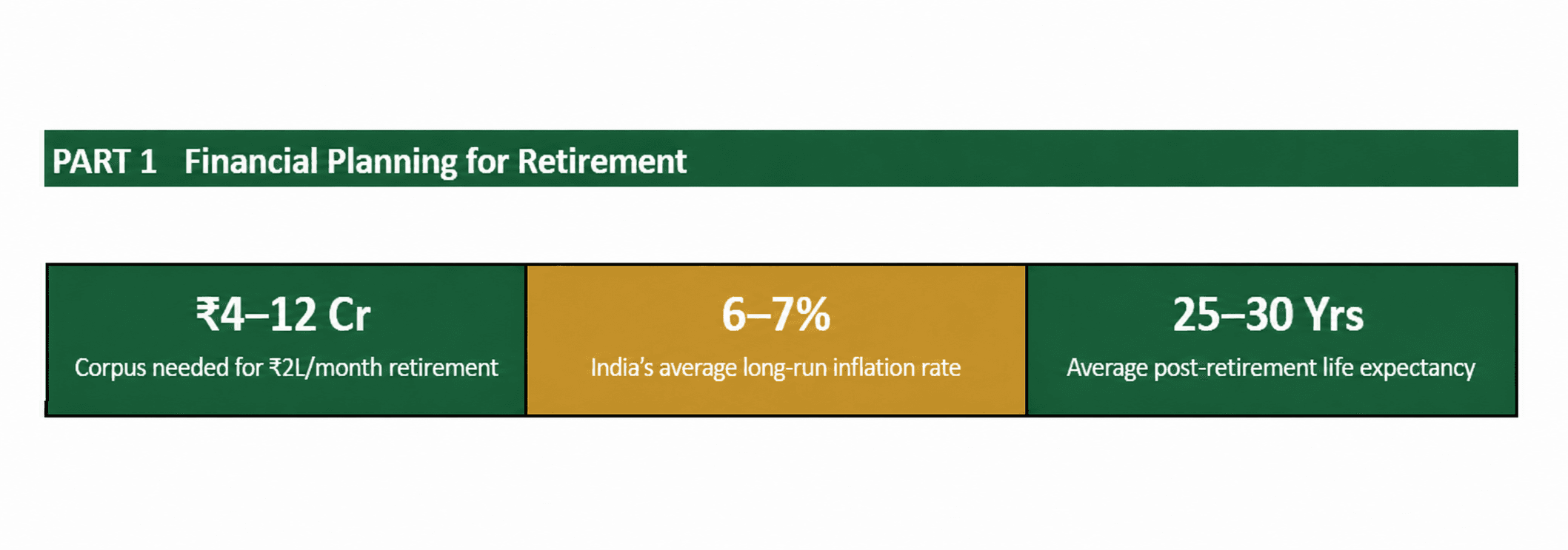
The Retirement Gap — Why India's Investors Are Under-Prepared
Most Indian professionals retire with EPF, a few fixed deposits, a house, and the hope that children will help. This is not a financial plan. With average life expectancy now crossing 75 years and healthcare inflation running at 12–14% annually, a retirement that begins at 60 could last 25–30 years. A 7% FD post-tax barely keeps pace with inflation — meaning your corpus is not growing, it is slowly being consumed.
The fundamental equation of retirement financial planning: your post-retirement corpus must generate enough monthly income to sustain your lifestyle, cover healthcare, account for inflation, and still not run out in your lifetime. Getting this right requires starting early and planning deliberately.
How Much Do You Actually Need?
The 4% withdrawal rule — widely used in financial planning globally — suggests you need a corpus 25x your annual expenses. For a ₹2 lakh/month lifestyle (₹24L/year), that means ₹6 crore in today's terms. Adjust for 6% inflation over 20 years and that number becomes ₹10–12 crore. Most Indian investors dramatically underestimate this figure.
The Retirement Financial Planning Toolkit
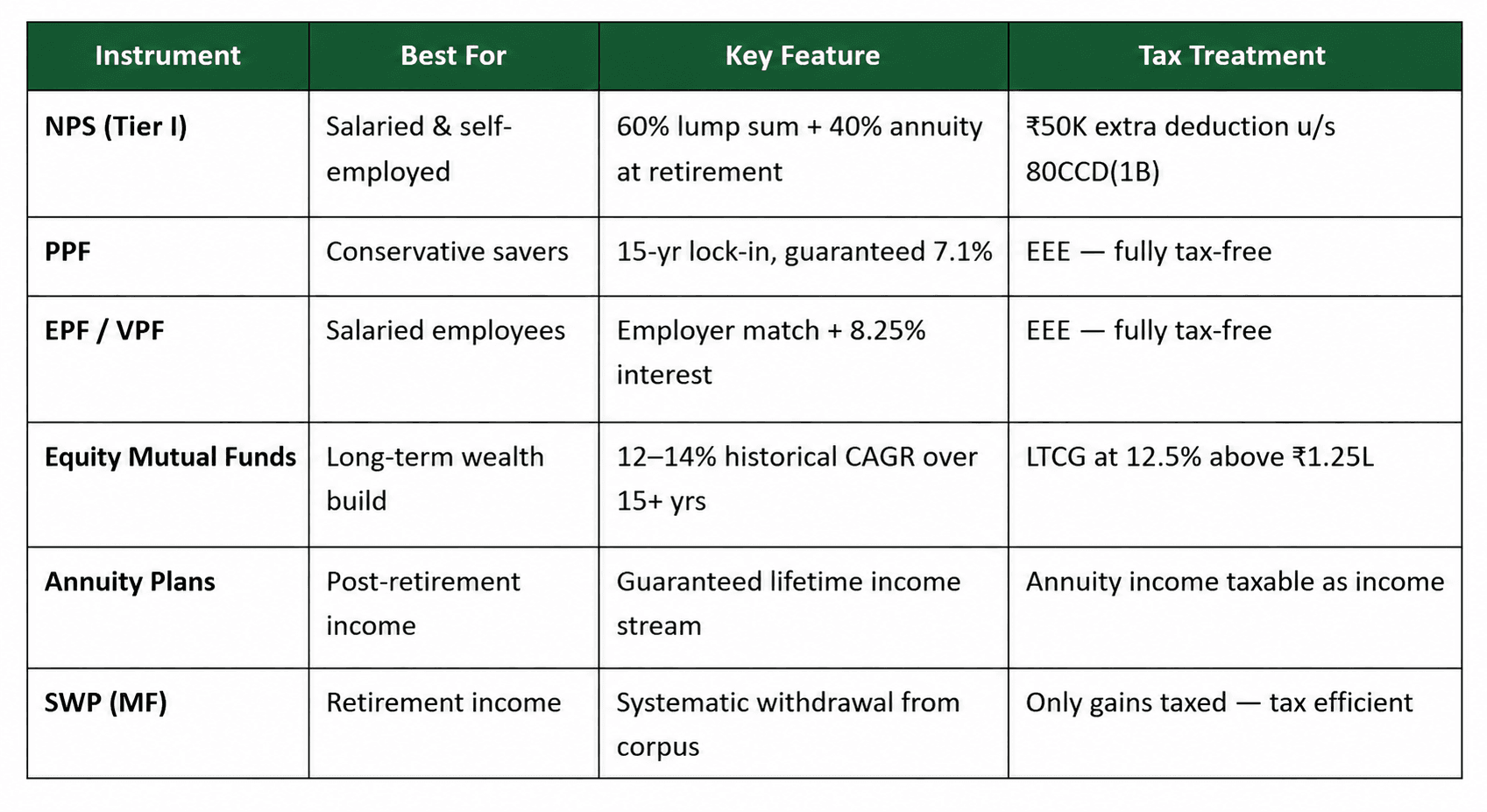
The Timeline-Based Approach to Retirement Financial Planning
• Age 25–35 (Foundation): Start SIPs in equity mutual funds. Maximise EPF/VPF. Open NPS Tier I. Goal: build ₹50–75L base corpus. Power of compounding works hardest here.
• Age 35–45 (Accumulation): Increase SIP amount with every salary hike. Add unlisted/pre-IPO exposure for alpha. Review insurance coverage. Goal: ₹2–4Cr corpus milestone.
• Age 45–55 (Consolidation): Reduce equity concentration, add debt and hybrid funds. Begin health corpus provisioning. Review NPS corpus projection. Goal: ₹5–8Cr target.
• Age 55–60 (Pre-Retirement): Shift to capital preservation. Structure SWP for post-retirement income. Plan annuity allocation. Settle all liabilities before retirement date.
The Retirement Financial Planning Rule of Thumb
Save at least 20% of your gross income from Day 1. Increase your SIP by 10% every year. Retire debt-free. Build 6 months of expenses as liquid emergency fund separate from your retirement corpus. Your retirement corpus and your emergency fund are two different buckets — never mix them.
Why High Income Doesn't Mean Financial Security
India is creating high-income earners faster than ever — senior professionals clearing ₹50L–₹2Cr annually, founders and entrepreneurs with multi-crore net worths, C-suite executives with large ESOP portfolios. Yet a surprising number of these individuals have no structured financial planning in place. They earn significantly, spend significantly, and invest reactively rather than strategically.
High income introduces unique financial planning challenges that standard retail advice cannot address: tax complexity, lifestyle inflation, concentrated wealth, and the pressure of sustaining a standard of living in retirement that matches the working years. Financial planning for high-income individuals must tackle all four.
The Four Unique Challenges of High-Income Financial Planning
• Tax Complexity: At ₹50L+ income, the effective tax rate under the new regime approaches 39% (including surcharge and cess). Every financial planning decision — whether to invest, which vehicle, in whose name — has a material tax consequence. Without proactive financial planning, high earners systematically overpay tax.
• Lifestyle Inflation: The single biggest destroyer of high-income wealth. When income grows 15% but expenses grow 20%, net savings actually shrinks. Financial planning for high earners must enforce a savings rate discipline — ideally 25–35% of gross income — regardless of income level.
• Concentrated Risk: Entrepreneurs often hold 70–90% of their net worth in one business. Senior professionals hold large chunks of a single employer's stock through ESOPs. This is not a portfolio — it is a concentration risk. Financial planning must systematically diversify this away.
• Retirement Gap: A ₹2L/month retirement is not enough for someone whose current lifestyle costs ₹8–10L/month. Financial planning for high-income individuals must model a retirement corpus large enough to sustain a high-income lifestyle — which typically means ₹20–40 crore or more.
The High-Income Financial Planning Framework
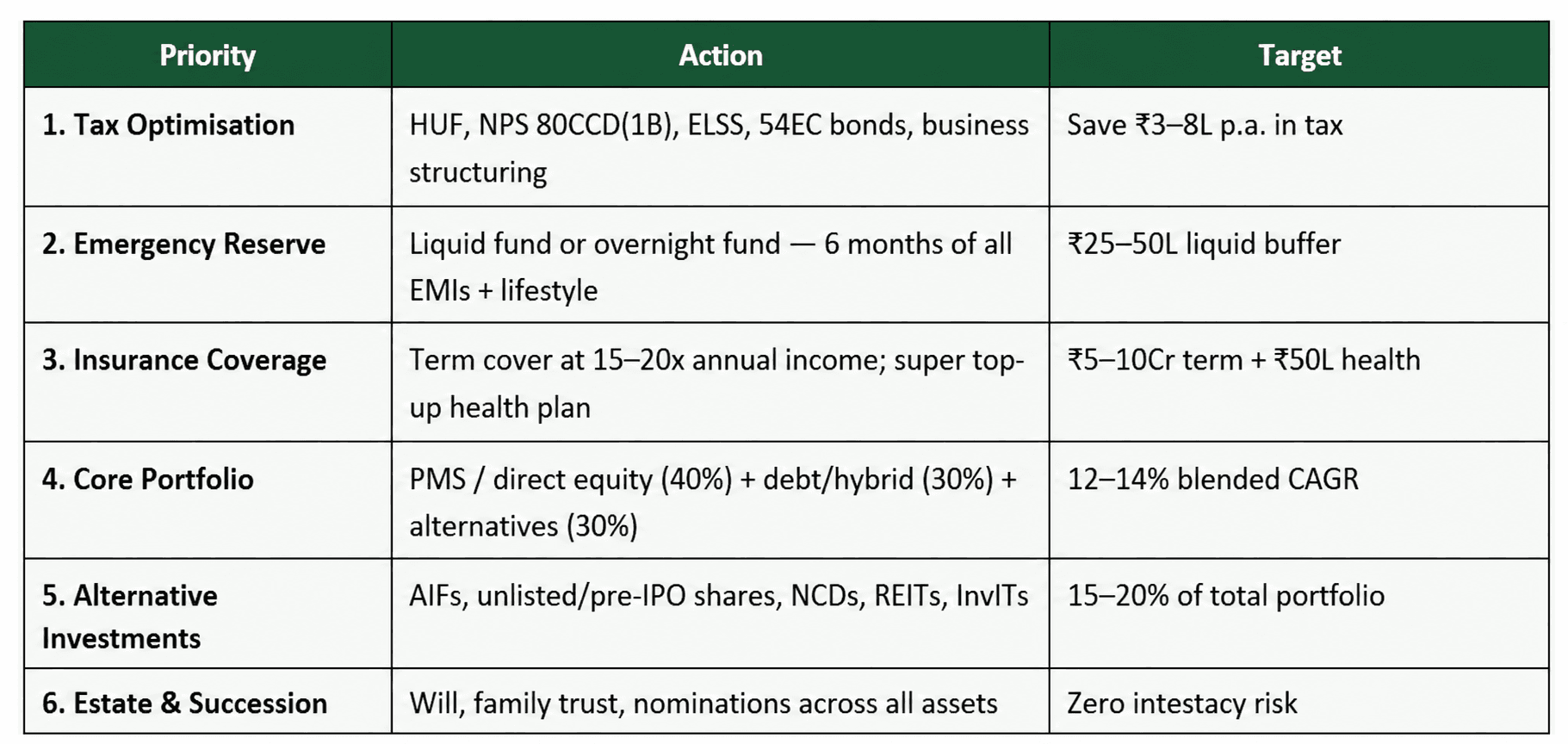
Tax-Efficient Financial Planning Strategies for High Earners
• HUF (Hindu Undivided Family): Creates a separate PAN and tax slab, enabling income splitting between the individual and the HUF. For those with ₹30L+ income, this alone can save ₹3–4L per year in tax.
• NPS 80CCD(1B): An additional ₹50,000 deduction beyond the ₹1.5L 80C limit. At 30%+ tax brackets, this saves ₹15,000–20,000 annually with the added benefit of retirement corpus building.
• LTCG Harvesting: Booking equity gains up to ₹1.25L annually (tax-free under LTCG) and reinvesting — a simple but consistently underused financial planning tactic that saves ₹15,625+ every year.
• ESOP Financial Planning: Perquisite tax at exercise and capital gains at sale — the two-stage tax on ESOPs creates significant complexity. Financial planning must model optimal exercise timing, diversification pace, and hedging strategies.
• 54EC Bonds for Real Estate Gains: Investing capital gains from property sale in 54EC bonds (NHAI/REC) within 6 months defers capital gains tax — a crucial tool in real-estate-heavy HNI portfolios.
Where Both Paths Converge: The Non-Negotiables of Financial Planning
Whether you are a 30-year-old building a retirement corpus or a 45-year-old high earner restructuring a ₹5 crore portfolio, the foundation of good financial planning is the same:
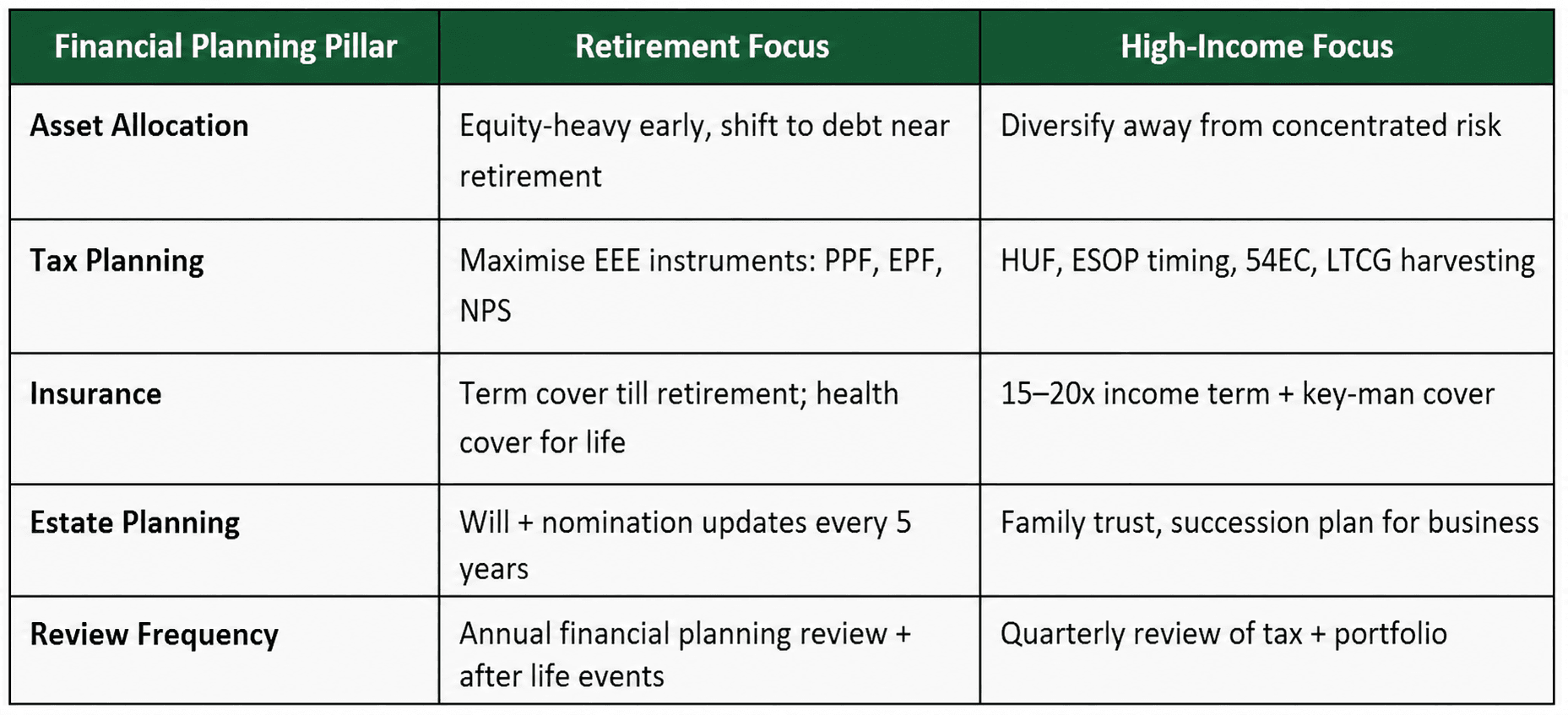
"Financial planning is not about how much you earn. It is about how much you keep, how well you protect it, and how efficiently you pass it on."
Final Thought
Retirement financial planning and high-income financial planning may seem like different problems — but they share the same root cause when they go wrong: the absence of structure. Money without a plan is just spending deferred. A disciplined financial planning framework — with the right instruments, the right tax strategy, and the right advisory support — is what separates wealth that compounds across decades from wealth that quietly disappears.
At We Grow Wealth, our financial planning advisory is built around your specific profile: your income structure, your asset base, your tax situation, and your retirement horizon. We don't sell products. We build plans.
Disclaimer: For informational and educational purposes only. Not investment or tax advice. Consult a SEBI-registered adviser and qualified CA before making financial planning decisions.
Begin Your Financial Planning Journey with We Grow Wealth
Noida-based wealth management firm specialising in retirement financial planning, HNI advisory, unlisted/pre-IPO shares, PMS, AIFs, mutual funds, and NCD distribution.
+91 8750563151 | www.wegrowwealth.in | info@wegrowwealth.in