What Is an IPO? Meaning, Process, Benefits, and Risks Explained
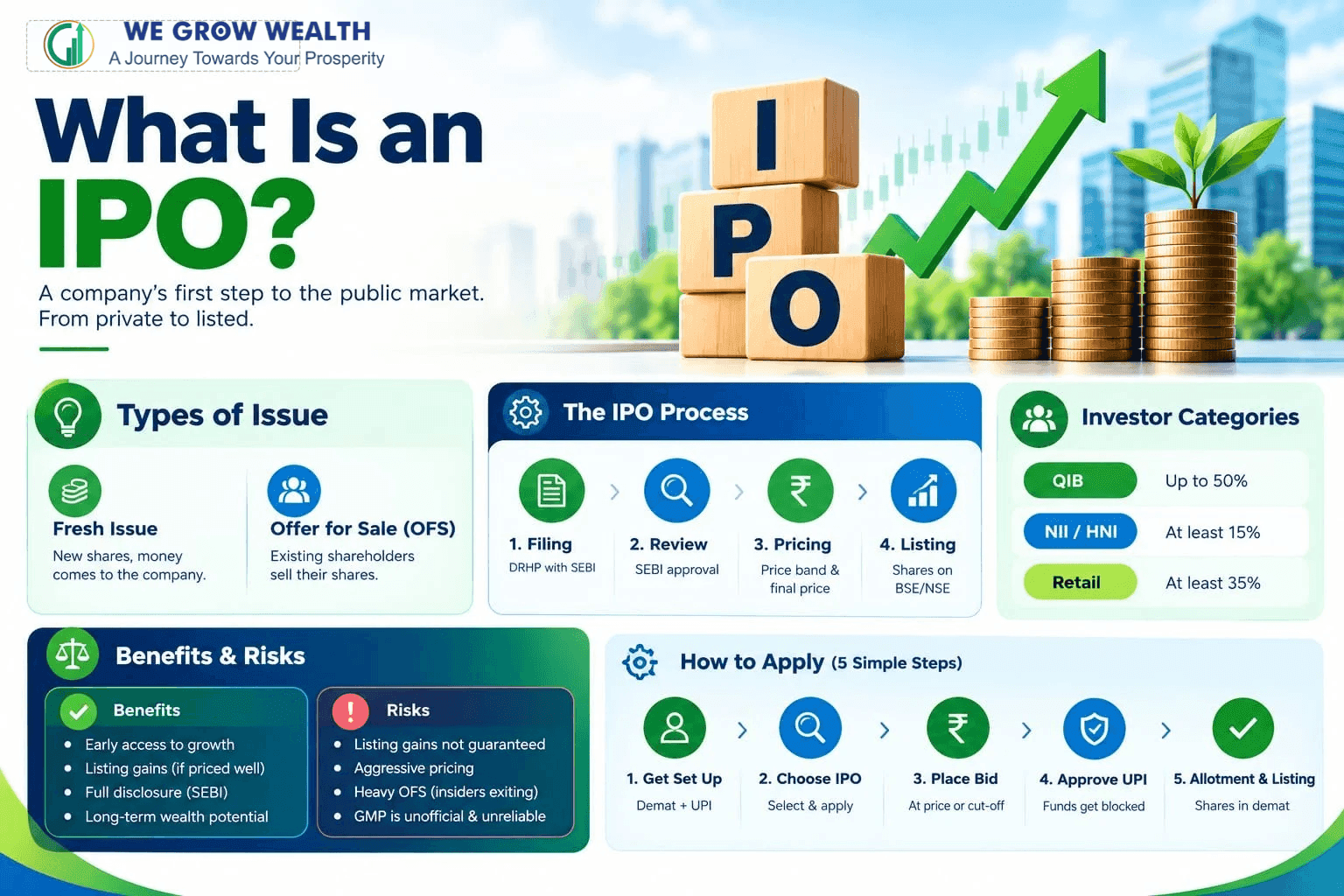
If you have ever wondered what is IPO and why headlines scream about it every few weeks, here is the short version: an IPO, or Initial Public Offering, is the moment a private company sells its shares to the public for the first time and gets listed on a stock exchange like BSE or NSE. Before the IPO, only founders, early investors, and private funds own the company. After it, anyone with a demat account can buy a piece of it.
"An IPO is not a discount coupon. It is a company asking you to buy its shares at a price it chose, at a time it chose."
What Is IPO? Two Types of Issue You Must Know
• Fresh Issue: The company creates new shares and sells them. The money goes into the company, for expansion, debt repayment, or working capital.
• Offer for Sale (OFS): Existing shareholders (promoters, PE funds) sell their own shares. The money goes to them, not the company. Many large IPOs, such as HDB Financial Services in 2025, mix both.
Pricing also works in two ways. In a book-building issue (the norm today), the company announces a price band, such as ₹700 to ₹740, and the final price is discovered from bids. In a fixed-price issue, the price is set upfront.
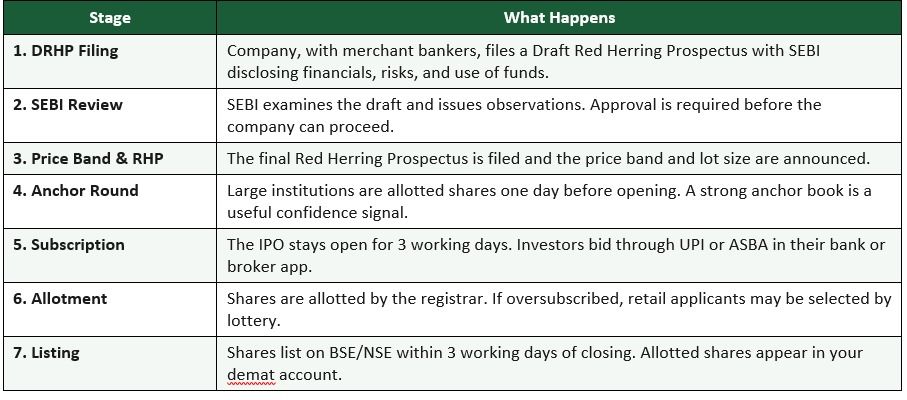
The IPO Process: From Filing to Listing
Who Gets What? Investor Categories

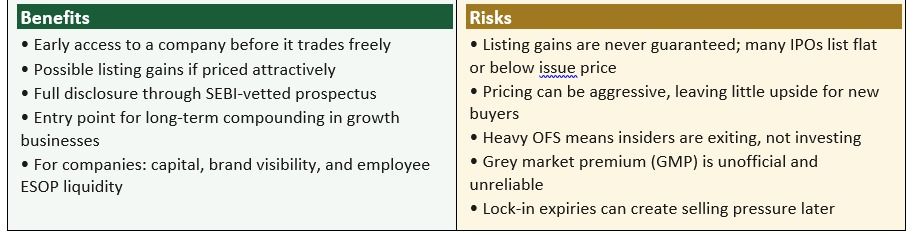
Benefits and Risks of an IPO
How to Apply for an IPO in 5 Steps
• Get set up: You need a demat account and a UPI-enabled bank account linked to your mobile number.
• Pick the IPO: Open your broker or bank app, select the issue, and choose the number of lots. Retail bids can go up to a total of ₹2 lakh.
• Choose your bid: Bid at the cut-off price to accept whatever final price is discovered, or at a specific price within the band.
• Approve the UPI mandate: Your money is blocked in your own account, not debited. It is released if you get no allotment.
• Check allotment: Status appears on the registrar website the day after closing. Shares reach your demat before listing.
Real Example: What Is IPO Success? HDB Financial Services
HDB Financial Services raised ₹12,500 crore in June 2025 at a ₹700 to ₹740 price band. Institutions bid 55.47 times their quota, while retail investors subscribed only 1.41 times. The stock still listed at ₹835, a 12.84% premium. The lesson: institutional demand, not retail excitement, drives most large-IPO outcomes.
Before You Apply: A Quick Checklist
• Read the RHP, not just the GMP. Check business model, promoter background, litigation, and use of proceeds.
• Look at valuation versus listed peers. P/E, P/B, or EV/EBITDA against comparable companies tells you if the price is fair.
• Check the fresh issue versus OFS split. A fully OFS issue is acceptable for a cash-rich leader, but a red flag for a cash-burning one.
• Watch QIB subscription on Day 3. Strong institutional demand is a better signal than retail hype.
• Decide your holding period first. Listing-day trade or long-term hold? Choose before you bid, not after.
Final Thought
Understanding what is IPO is the easy part. The skill lies in separating quality businesses at fair prices from good stories at expensive ones. Treat every IPO like any other investment: read the prospectus, question the valuation, and invest only what you can leave alone for years.
Disclaimer: For informational purposes only. Not investment advice. IPO investments carry market risk and possible loss of capital. Consult a SEBI-registered adviser before investing.
Invest in IPOs with Confidence, with We Grow Wealth
Noida-based wealth management firm offering IPO advisory, unlisted/pre-IPO shares, mutual funds, PMS, AIF, and NCD services.
+91 8750563151 | www.wegrowwealth.in | info@wegrowwealth.in