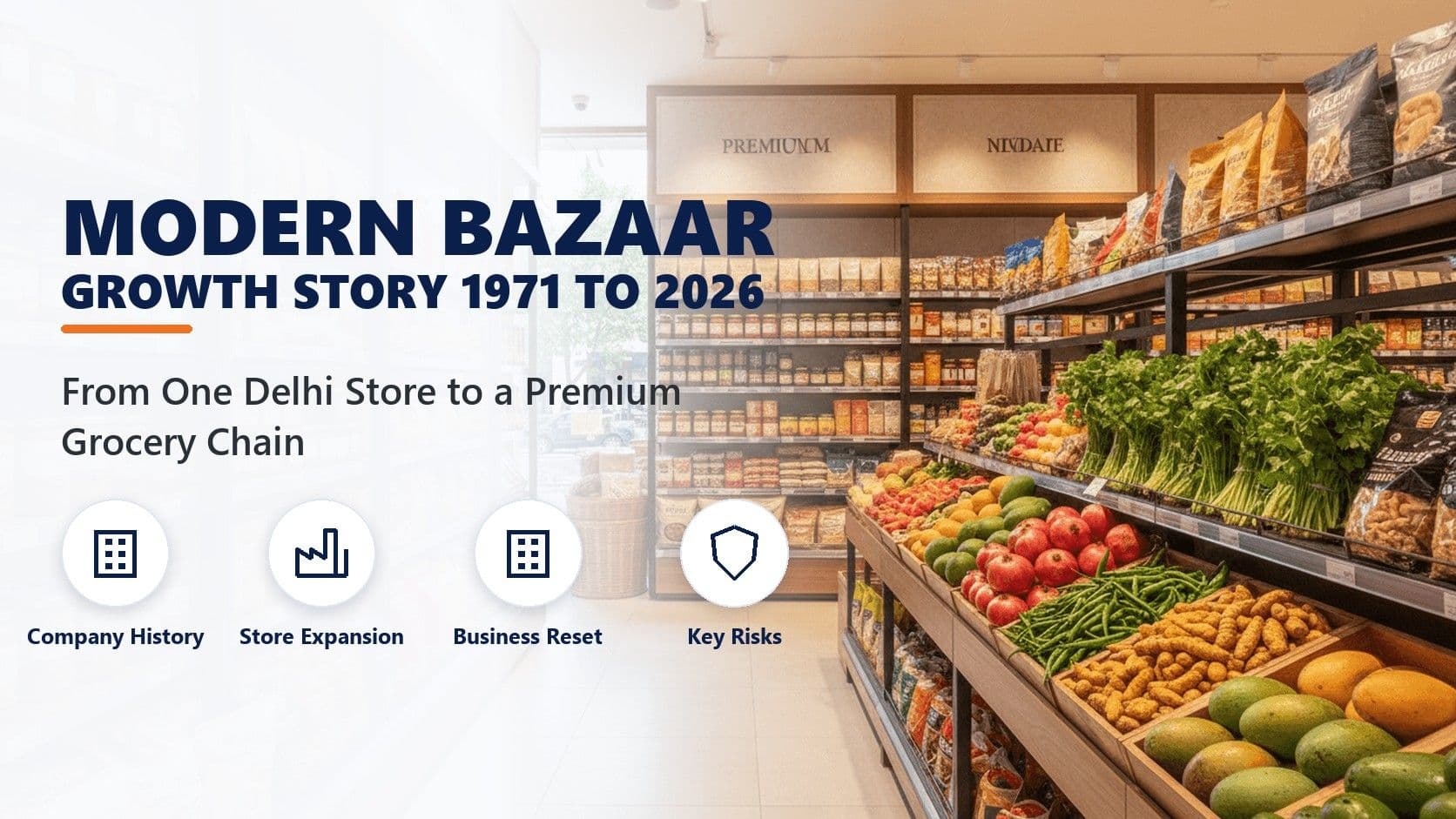
Modern Bazaar's Growth Story: From One Delhi Store in 1971 to a Premium Grocery Chain at a Turning Point
Long before quick-commerce apps promised groceries in ten minutes, a small store in South Delhi was already doing something unusual: stocking imported foods that few Indian shops carried. That store was Modern Bazaar, opened in Vasant Vihar in 1971. Over five decades it became a familiar name for Delhi's premium grocery shoppers, survived a fire that destroyed its flagship, and grew into a multi-store chain. The last two years have been harder. Shoppers have moved online, the company has closed a large part of its network, and it is looking for a strategic partner. For anyone who holds or is considering Modern Bazaar shares, the history explains what the brand is worth, and the recent reset explains what has to go right next. This article traces both.
Key Takeaways
- A 55-year-old brand: Modern Bazaar began in 1971 as a single store selling imported foods in Vasant Vihar, New Delhi.
- Second generation: Kunaal Kumar joined in 1991 and rebuilt the business after a fire destroyed the Basant Lok store in 2004.
- Rapid expansion, then a reset: The chain grew to roughly 28 to 30 stores before cutting back to around 14 to 18 in 2026, with a shift to smaller Express formats.
- Revenue under pressure: FY25 revenue was reported at about ₹247 crore, down about 13.6 percent from the previous year.
- Partner search: Reports in 2026 said the company was in talks with large retail groups about a strategic investor; no agreement has been announced.
How it began: a Vasant Vihar store in 1971
The late Vishwant Kumar opened the first Modern Bazaar in the C-Block market of Vasant Vihar in 1971. At a time when most Indian shoppers bought groceries from neighbourhood kirana stores, his store offered packaged imported products under one roof. That idea, ordinary today, was rare then.
From one floor to a four-storey store
The business moved to the Basant Lok market in 1976 and grew from a single floor into a four-storey store. For South Delhi households, diplomats and expatriates, it became the place to find cheeses, sauces and breakfast foods that were otherwise hard to buy in the city.
The fire that forced a rebuild
In 2004 a fire destroyed the Basant Lok store. Many family retailers would not have recovered. Kunaal Kumar, who had joined the business in 1991, reopened in Vasant Vihar in 2005 and used the rebuild to modernise the format, systems and supplier base.
How Modern Bazaar grew into a Delhi-NCR chain
After the rebuild, the company expanded steadily across South and Central Delhi, then into Gurgaon, Noida, Faridabad and Chandigarh. The legal entity behind the stores, New Modern Bazaar Departmental Stores Private Limited, was incorporated in 2013 as the business scaled up.
What set the stores apart
Modern Bazaar positioned itself between a supermarket and a gourmet food hall. Large stores carried imported and specialty products alongside everyday essentials, an in-house bakery and fresh produce. That mix built loyalty among higher-income shoppers who wanted range and quality more than the lowest price.
Expansion at its peak
By the early 2020s the chain operated large-format stores in premium malls and neighbourhood markets, and spoke of reaching 25 stores and opening at locations such as Delhi airport. At its peak, reports put the network at roughly 28 to 30 locations.
Why Modern Bazaar had to reset
The same shoppers who made Modern Bazaar successful were among the first to adopt quick-commerce apps. Orders that once meant a trip to a large store increasingly went to ten-minute delivery services.
Fewer, smaller stores
Over the past year the company closed a number of large stores, including several in malls and high-rent locations, and has been shifting towards smaller Express formats that cost less to run. Reports in 2026 put the remaining network at around 14 to 18 stores. Store counts vary between sources and dates, so treat any single number with caution.
Pressure on revenue and working capital
FY25 revenue was reported at about ₹247 crore, down about 13.6 percent year on year, with profit close to break-even. Reports also pointed to pressure on working capital and supplier terms, a common strain when a retailer closes stores while sales fall.
The strategic partner question
In 2026 the company was reported to be in talks with large retail groups about bringing in a strategic investor. Management has said the business is not for sale and that the aim is a partner who can strengthen operations. No agreement had been announced as of 27 October 2026, and there is no public plan for an IPO.
What a partner could change
A larger retail group could bring purchasing scale, better supplier terms, technology for online orders and the capital to run a smaller, more profitable store network. It could also reprice the company, up or down, depending on the terms of any deal.
Why the outcome matters to shareholders
Unlisted shareholders do not get a vote on most of these decisions, but the price of any strategic deal is likely to become the new reference point for the value of Modern Bazaar shares. Watch for the terms, not just the headline.
Modern Bazaar shares at We Grow Wealth today
| Parameter | Detail |
|---|---|
| Company | New Modern Bazaar Departmental Stores Private Limited |
| Brand founded | 1971, Vasant Vihar, New Delhi |
| Company incorporated | 2013 |
| Indicative price | ₹63 per share, We Grow Wealth quote as on 27 October 2026 |
| Lot size | 5,000 shares |
| Minimum investment | ₹3,15,000 (5,000 shares at ₹63) |
| Market value shown on our page | About ₹775 crore |
| ISIN | INE2SEU01018 |
Indicative price as on 27 October 2026, based on the We Grow Wealth quote. Unlisted shares are not traded on any stock exchange and are not regulated by SEBI. Prices are not guaranteed and may differ at the time of the deal.
At about ₹775 crore, the market value shown is roughly three times FY25 revenue. That is a demanding level for a grocery retailer with shrinking sales, and any strategic deal could be priced differently. For the current quote and company details, see the Modern Bazaar unlisted share price page, and for an earlier look at the numbers, read our Modern Bazaar valuation analysis.
Risks a shareholder should weigh
Competition from quick commerce
Ten-minute delivery apps compete directly for the premium, convenience-minded shopper. A smaller store network has to win on range and experience, not speed.
Execution of the reset
Closing stores cuts costs but also cuts revenue. The Express format has to prove it can earn more per square foot than the large stores it replaces.
Liquidity and price
There is no exchange to sell on, the lot size is large, and the reference price may move sharply if a strategic deal is announced at a different valuation.
Limited disclosure
As a private company, Modern Bazaar files annual accounts rather than quarterly results, so problems and improvements show up late.
What would make the next chapter a success
Three signs would show the reset is working. First, sales per store rising in the smaller format, which would show that fewer stores can still earn more. Second, steadier supplier terms and working capital, which would show the balance sheet has stabilised. Third, a strategic partner on terms that recognise the strength of a brand Delhi shoppers have trusted since 1971. Until those signs appear, Modern Bazaar is best seen as a well-known brand in the middle of a turnaround, not a company on a straight growth path.
Frequently Asked Questions
Who founded Modern Bazaar?
The late Vishwant Kumar opened the first Modern Bazaar in Vasant Vihar, New Delhi, in 1971. His son Kunaal Kumar joined in 1991 and now leads the business.
How many Modern Bazaar stores are there?
Reports in 2026 put the network at around 14 to 18 stores after a year of closures, down from roughly 28 to 30 at its peak. The company is shifting to smaller Express stores, so the count is changing.
Is Modern Bazaar shutting down?
No. The company has closed a number of large stores and is reshaping its network around smaller formats, but it continues to operate across Delhi-NCR and is in talks about a strategic partner.
What is Modern Bazaar's revenue?
FY25 revenue was reported at about ₹247 crore, down about 13.6 percent from the previous year, with profit close to break-even.
Is Modern Bazaar planning an IPO?
There is no public IPO plan. Reports in 2026 focused on talks with potential strategic investors, and no agreement had been announced as of 27 October 2026.
What is the minimum investment in Modern Bazaar shares?
At our quote of ₹63 and a lot of 5,000 shares, the minimum is ₹3,15,000. Because lot sizes are set by the seller, ask us to confirm the current lot and the total amount in writing first.
Disclaimer: This content is for information and education only and is not investment advice or a recommendation to buy, sell or hold any security. Unlisted shares are not traded on any stock exchange and are not regulated by SEBI; investors do not get exchange or SEBI investor-protection or dispute-resolution mechanisms. Prices shown are indicative, are negotiated privately, may differ across platforms and are not guaranteed. Unlisted shares can be hard to sell and you may lose part or all of your investment. An expected IPO may be delayed or may not happen; if the company lists, pre-IPO shares are locked in for 6 months from the date of IPO allotment. Tax treatment is as per law on the date of publication and may change. We Grow Wealth earns a margin on the difference between its buy and sell prices. Please consult a qualified adviser before investing.